

Short answer
If you were hit by a car in New Jersey, your own PIP coverage normally pays first if you have an auto policy. If you don't, a policy of a relative you live with may pay, or the policy of the car that hit you. If the driver had no insurance or fled, you can file a claim with the Unsatisfied Claim and Judgment Fund (UCJF), giving notice within 180 days.
Key points
- Your PIP follows you, not the car: it also covers you when you were walking.
- If you don't have a policy, one belonging to a relative you live with may pay first.
- The policy of the car that hit you covers pedestrians who have no other coverage.
- If the driver fled or had no insurance, there's the state UCJF fund, with notice due within 180 days.
- Your immigration status doesn't decide whether you're entitled to treatment.
The order insurance pays when you're a pedestrian
Being a pedestrian doesn't leave you outside New Jersey's insurance system. Just the opposite: the law is designed so there's almost always a policy that pays for your treatment. What changes is which one. The general order is this:
- Your own auto policy, if you have one. Your PIP coverage covers you even though you weren't driving.
- The policy of a relative who lives with you, if you don't have your own policy. For example, your spouse's, your parents', or a child's who lives in the same home.
- The policy of the car that hit you, if no one in your home has an auto policy.
- The state UCJF fund, if the car had no insurance or the driver fled and couldn't be identified.
This order can have exceptions depending on the details of each policy, but it's the starting point. What matters is knowing there's an answer for almost every case.
If you have an auto policy
Many people are surprised: even though they were walking to work or crossing the street to go to the store, their own auto insurance is what pays first. That's because PIP in New Jersey protects the insured person, not just the vehicle.
This doesn't mean you were at fault or that your premium will go up because of it. PIP is no-fault coverage. Your insurer pays for your medical treatment up to your policy limit, and then there can be a separate claim against the driver who hit you.
Check how much PIP you have before you start long treatment. In this guide we show you where to find the limit on your declarations page.
If you don't have an auto policy
If you don't have a car or insurance, the next step is to check whether someone who lives in your home has a New Jersey auto policy. In many cases, that policy also covers relatives who live in the same household.
If no one in your home has a policy, New Jersey law (N.J.S.A. 39:6A-4) makes the policy of the car that hit you pay PIP benefits to pedestrians injured by that vehicle. That's why it's so important to get the car's plate and the name of the driver's insurance company.
Your right to treatment doesn't depend on your immigration status or on whether you own a car. It depends on the facts of the accident.
If you're undocumented and worried about filing a claim, read our guide I was in an accident and I'm undocumented.
If the driver fled or had no insurance
Hit-and-run accidents are, unfortunately, common. If that happened to you, you still have options.
Report it to the police the same day
Call 911 or go to the police station in the city where the accident happened as soon as possible. The police report is what later lets you open the claim. Write down everything you remember about the car: color, make, part of the plate, the direction it went.
The Unsatisfied Claim and Judgment Fund (UCJF)
New Jersey has a state fund called the Unsatisfied Claim and Judgment Fund (UCJF), run by the New Jersey Property-Liability Insurance Guaranty Association (NJPLIGA). This fund gives limited protection to people injured by uninsured vehicles or hit-and-run drivers, when no other policy applies.
The deadline is strict: according to NJPLIGA, you must file a Notice of Intention to Make a Claim within 180 days of the date of the accident. If you miss that deadline, you may lose the right to collect. The fund also asks for documents like the PIP application, proof of residence, and a copy of the police report.
Your uninsured motorist (UM) coverage
If you have an auto policy, check whether it includes uninsured motorist coverage (uninsured motorist, or UM). That coverage can pay you for your injuries when the at-fault driver has no insurance or can't be identified.
Does it matter if I crossed outside the crosswalk?
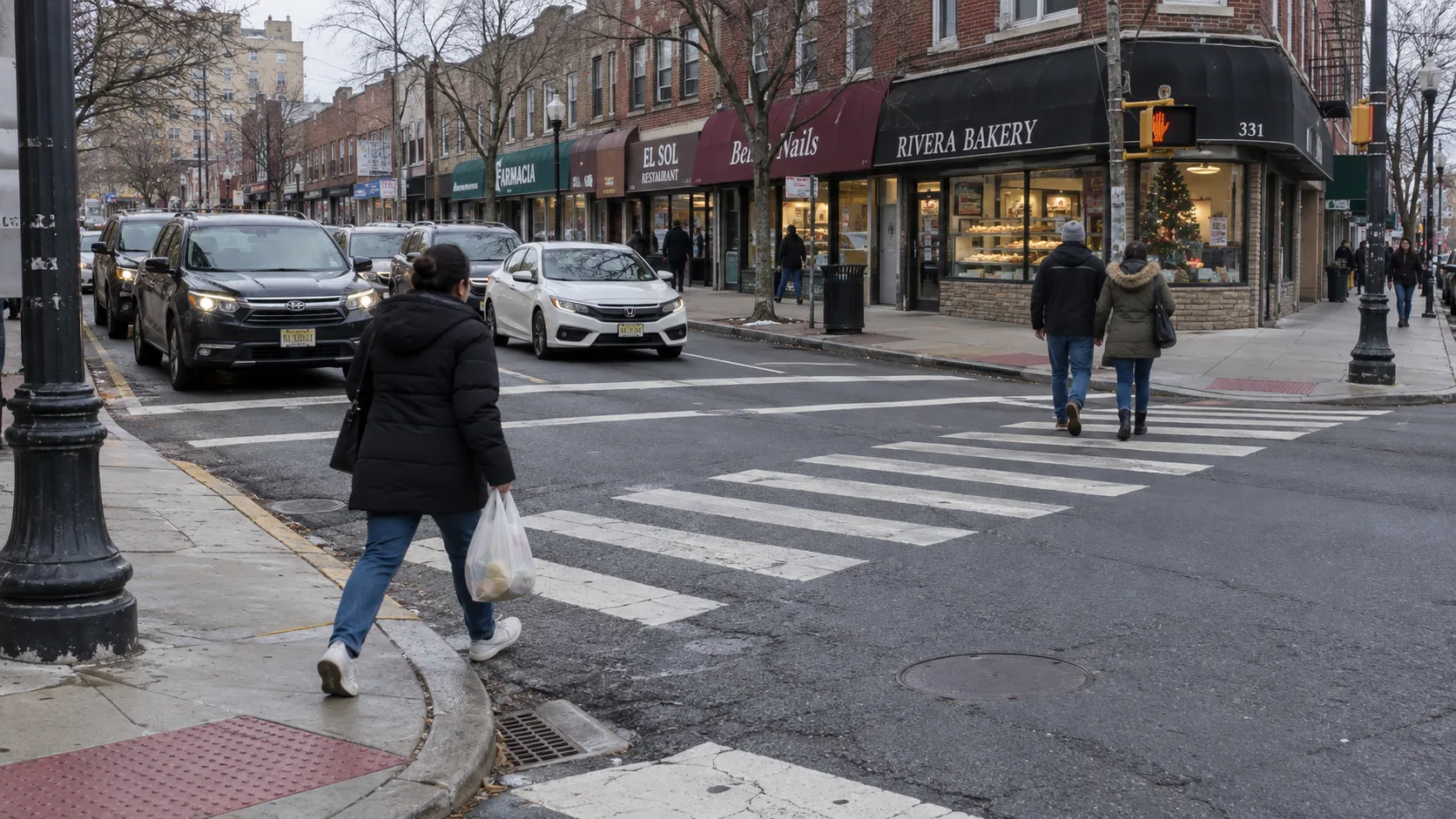
For PIP, no. PIP pays regardless of fault. For a claim against the driver, it can matter. New Jersey uses comparative fault: if you were partly at fault, your compensation is reduced by that percentage, and if your fault is greater than the driver's, you can't collect from them.
That's why it's not a good idea to accept blame at the scene or on calls with insurance companies. Often the driver was speeding, distracted by their phone, or didn't yield at the crosswalk. New Jersey law requires drivers to stop and yield to pedestrians in crosswalks. Cameras at nearby businesses and witnesses can show what really happened.
Pedestrian accidents in Newark, Paterson, Elizabeth, Union City, and Union
North Jersey cities have heavy foot traffic: Bergenline Avenue in Union City, Main Street in Paterson, Broad Street in Newark, the Elizabeth Avenue area in Elizabeth, and Morris Avenue in Union. On streets like these, stores often have cameras, and there are people on the street who may have seen the accident.
If you were hit in one of these areas, ask someone you trust to go back to the scene soon and ask the businesses whether they have video. Many systems delete it within a few days. NHTSA, the federal road safety agency, publishes pedestrian safety information that may also be useful for your family.
The most common injuries when hit by a car
A pedestrian has no protection against a car. That's why injuries in pedestrian accidents tend to be more serious than in crashes between vehicles, even at low speed. The most common are fractures in the legs, hips, and arms, head injuries from hitting the pavement, back and neck injuries, and deep cuts and scrapes.
Head injuries deserve special attention. A concussion may not show at the moment, but it can cause headaches, dizziness, memory problems, or mood changes in the following days. If you hit your head, tell the doctor even if you didn't lose consciousness.
If your injury is serious, remember that according to DOBI, certain permanent or significant injuries can be covered up to $250,000 even if the policy has a lower limit.
If you were on a bike, skateboard, or scooter
The same general rules usually apply to cyclists hit by a car: the PIP from your policy or a relative you live with, the policy of the car that hit you, and, if the driver fled or had no insurance, the UCJF fund. Electric scooters and e-bikes can have particular rules depending on the type of vehicle. If you were on one, tell us the details so we can check which coverage applies.
If the injured person is a child or an older adult
Children and older adults are the most vulnerable pedestrians. If your child was hit, the parents' auto policy normally covers them as a relative living in the home. Deadlines to file a claim can be different for minors, but it's not a good idea to wait: evidence disappears just as fast.
If the injured person is an older adult on Medicare, tell the doctor and the insurer from the start. Medicare has its own rules about who pays first and about reimbursement when there's an injury claim.
Documents you'll be asked for in the claim
Having these papers ready speeds up the process, both with an insurance company and with the UCJF fund:
- A copy of the police report.
- Proof of residence, like a utility bill or a lease.
- The details of your household's auto policy, if there is one.
- Medical records and bills.
- Proof of missed work days.
If the driver fled, NJPLIGA also asks for forms like the Notice of Intention to Make a Claim, the PIP application, and an affidavit of eligibility. We can help you understand which ones you need.
How much is a pedestrian case worth?
There's no fixed number, and be wary of anyone who promises an amount before seeing your file. The value of a case depends on how serious the injuries are, the cost of treatment, how long you couldn't work, whether the injury is permanent, who was at fault, and how much insurance the at-fault party has. That's why it's important to document everything from the start: every doctor visit, every receipt, and every missed work day builds the case.
An attorney licensed in New Jersey can give you a clearer idea after reviewing your medical records and the driver's policy.
What to do today if you were hit by a car
- Get medical care and describe everything that hurts, even if it seems minor.
- Get the police report number and the name of the department.
- Write down names and phone numbers of witnesses.
- Take photos of your injuries, the scene, and your clothes and shoes.
- Find out whether anyone in your home has an auto policy and get the number.
- Don't sign anything from any insurance company yet.
- Mark the 180 days on your calendar if the driver fled or had no insurance.
For a more complete list, see what to do in the first 48 hours. If you want us to check which policy applies to you, call us at 908-287-9998 or send us your info. It's free, in English or Spanish.
Frequently asked questions
Does my auto insurance cover me if I was hit while walking?
Yes. In New Jersey your PIP coverage protects you as a person, so it normally pays first even though you were walking.
Who pays if I don't have auto insurance and I was hit by a car?
A policy of a relative you live with may pay. If no one in your home has a policy, the policy of the car that hit you pays PIP benefits to pedestrians.
What happens if the driver fled?
Report it to the police the same day. If no other policy applies, you can file a claim with the state UCJF fund by submitting a notice of intent within 180 days of the accident.
Can I file a claim if I crossed outside the crosswalk?
PIP pays no matter who was at fault. In a claim against the driver, your compensation may be reduced by your share of fault, as long as it isn't greater than the driver's.
Do I need papers to file a claim as a pedestrian?
In general, no. The right to treatment and to file a claim doesn't depend on immigration status.
What if a car hit me while I was on a bike?
In general the same rules apply as for a pedestrian: your PIP or that of a relative you live with, the policy of the car that hit you, or the UCJF fund if the driver fled or had no insurance.
How long do I have to notify the UCJF fund?
According to NJPLIGA, you must file the Notice of Intention to Make a Claim within 180 days of the date of the accident.
Sources
This article is general information, not legal advice. Laws and policies change; confirm the details of your case with an attorney licensed in New Jersey. Accidente en NJ is a referral service operated by Liberty Billing Solutions LLC, not a law firm.